.webp)
Live Video ads explained
Meta Live Video Ads let brands promote an eligible Facebook or Instagram livestream using the broadcast itself as the ad creative. For retailers running Live Shopping, paid media can bring new viewers into a show where they can see products demonstrated, ask questions and shop.
Live Shopping has moved well beyond the experimental stage. For brands already investing in livestreams, the next opportunity isn’t necessarily to create more content—it’s to get more from the content you’re already creating.
Instead of producing a separate video ad, you can put paid media behind the live show you’re already planning and reach beyond your existing audience.
That changes the role of the livestream. Alongside serving your existing community, it can become a paid acquisition channel that introduces new customers to your brand through real-time demonstrations and conversation.
This guide explains how Live Video Ads work, what Meta’s early data shows and how to prepare your next Live Shopping show for paid distribution.
The opportunity sits within a growing market. ARK Invest projects global live commerce revenue could reach $3.7 trillion by 2030, with the following regional breakdown:
What are Meta Live Video Ads?
Live Video Ads let advertisers amplify a live broadcast on Facebook or Instagram with paid media.
The important part? The livestream itself is the creative.
There’s no need to produce a separate video asset, organise another shoot or create an additional campaign concept. You’re already going live to demonstrate products, answer questions and interact with customers. Live Video Ads allow you to put budget behind that experience and bring it to people who might not otherwise discover your brand.
This creates a simple connection:
Go live → reach new audiences → bring them into the experience → give them a reason to buy.
For brands already running live shopping, it means getting more value from an asset you’re already investing time and resources into. And for brands exploring live commerce for the first time, it creates a powerful opportunity to introduce new shoppers to your brand through an engaging, interactive product experience.
You can learn more about Live Shopping in general here: Live Shopping: Everything you need to know
Why Live Video Ads matter for Live Shopping brands
A typical livestream naturally starts with your existing audience. Your followers receive a notification, your community joins, and you sell to people who already know your brand.
But what happens if you could take that same show beyond your existing followers?
That’s where paid distribution becomes interesting.
Live Video Ads combine the reach of paid social with the immediacy of live commerce. Instead of sending a new customer straight to a product page or showing them a polished, pre-recorded product video, you can bring them into an experience where a real person is presenting products, answering questions and demonstrating them in real time.
And there’s evidence that consumers are already behaving this way.
80% of US livestream shoppers surveyed by Adobe Express said they had discovered a new brand or product through a live shopping event, while 66% said they had made a purchase after randomly clicking into a livestream.
Live isn’t only about selling to people who already know you. It can also be a discovery channel.
The livestream becomes the ad
This is perhaps the biggest shift to understand.
Traditionally, the Live Shopping event and the paid media campaign have been two separate things.
You might:
- Create a livestream.
- Promote the event beforehand.
- Go live.
- Reach your existing social audience.
- Create separate video ads to acquire new customers.
With Live Video Ads, the livestream itself can become and ad.
The show you're already doing can be used to reach people outside your existing audience — while the live experience gives those new viewers an immediate reason to stay, interact and shop.
That makes the livestream work harder without requiring your team to produce another piece of creative.
Live Video Ads vs. a regular video ad
A standard video ad is designed to communicate a message quickly. A Live Video Ad has another advantage: context.
A viewer can see a host demonstrating a product, explaining how it works, answering questions from the audience and reacting to what is happening in real time.
That interaction can help remove some of the uncertainty that often stands between discovering a product and buying it.
For fashion, for example, a host can show how a garment fits, answer sizing questions and style it in different ways.
For beauty, they can demonstrate application and answer questions about the product.
For home and lifestyle, they can show a product in use rather than simply showing a polished product image.
The format works particularly well when real-time demonstration, unscripted explanation, and live interaction add a level of context and confidence that a standard, pre-recorded video ad cannot provide.
What does the data say?
Meta's early data points towards some interesting differences between Live Video Ads and standard campaigns.
One particularly important takeaway is the difference between scheduled and unscheduled Live Video Ads.
If you already know when your show is happening, planning the paid campaign around it gives the format a much stronger foundation than simply deciding to boost a livestream after it has started.
In other words: treat the livestream as a media placement, not an afterthought.
How to make Live Video Ads work harder
Putting budget behind a livestream doesn’t automatically make it successful.
The strongest results still depend on the fundamentals of good live shopping.
1. Start with a clear goal
Before you go live, decide what the show needs to achieve. The format carries the same flexibility as any other Meta ad, meaning a brand can point the same live broadcast at a different objective depending on where it sits in the funnel:
Live Video Ads can be optimised towards different funnel objectives, so the goal of the campaign should influence how you structure the show.
2. Schedule your campaign
If your livestream is already part of your marketing calendar, your paid media around it should be too.
Planning the campaign in advance allows you to build the audience before the show starts and make sure your media strategy is aligned with the moment you actually want people to join.
The scheduled live ads also gives you a performance boost in advance- According to Meta the median time to first ad delivery is 2.25 minutes when scheduled, versus 12.2 minutes when not scheduled.
The gap between scheduled and unscheduled performance is the clearest signal in the data. A live show planned and booked in advance behaves like a proper media placement. One switched on ad hoc behaves like an afterthought.
3. Give people a reason to stay
Getting someone into the livestream is only the first step.
Your host, product selection and format need to give viewers a reason to keep watching.
That could be a product launch, exclusive offer, demonstration, styling session, Q&A or simply a host who knows how to make the experience entertaining.
The production doesn’t have to be perfect. In live commerce, authenticity and interaction are part of the value.
4. Make the products easy to shop
The easier it is for viewers to go from “That looks good” to “I want that”, the better.
Your product setup, inventory and checkout experience should be ready before you go live, so your team can focus on the show rather than solving technical problems while customers are watching.
This can easily be solved by using a Live Shopping platform.
5. Learn from every show
Live shopping generates a lot of useful data.
Look at which products attracted attention, when viewers joined and dropped off, which moments generated engagement and what ultimately drove sales.
Then use those insights to improve the next show — and the paid campaign supporting it.
Live shopping works best as a process, not a one-off event, as it allows you to learn and improve continuesly.
Think of your livestream as a full-funnel asset
One of the most interesting things about Live Video Ads is that the same livestream can serve different purposes depending on where someone is in the customer journey.
At the top of the funnel, it can help introduce your brand to new audiences.
Further down, it can drive video views, engagement and traffic.
And closer to conversion, it can support website sales, messaging or app activity.
That means you don't necessarily need to create a completely different piece of content for every stage of your funnel.
One live show can have multiple jobs.
And because the content is already being created for your live shopping strategy, paid amplification can extend the value of that investment.
What happens after the livestream?
The value of a live show doesn’t necessarily end when you stop streaming.
The recording can continue working as content after the event, while individual moments can be repurposed into short-form videos, product demonstrations, social content and paid creative.
That gives live shopping a longer content lifecycle than the live moment alone.
And when you combine that with paid distribution, a single live show can contribute to multiple parts of your marketing strategy.
Where Sprii fits in
Running a successful livestream involves more than simply pressing “Go Live”.
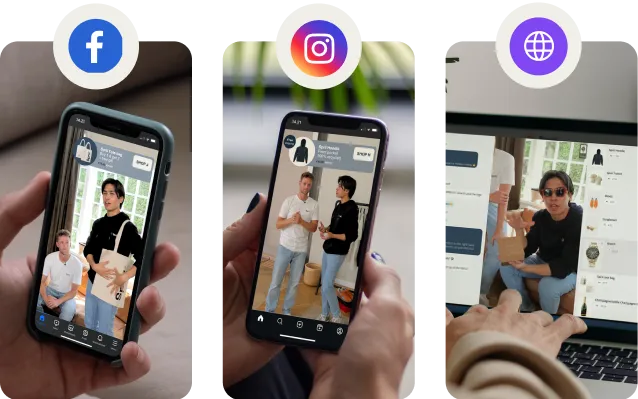
Sprii helps brands and retailers run shoppable livestreams across Facebook, Instagram and their own website from a single broadcast, with real-time interaction, analytics and commerce built into the experience.
That means your livestream can already be set up as a sales environment before you add paid distribution.
And as Live Video Ads turn the livestream itself into a paid media asset, the combination becomes particularly powerful:
Create the live show once. Multistream it. Make it shoppable. Then put paid media behind it.
Sprii is also a Live Video Ads Partner, working directly with Meta on the format and helping customers get the data and infrastructure they need to make the most of their live campaigns.
Do you need to already use Sprii?
No.
Live Video Ads are a Meta advertising format available to brands advertising on Facebook and Instagram.
Sprii’s role is to help you run the livestream itself — including multistreaming, live commerce, webiste integration and analytics — so your broadcast is ready to become a paid media asset.
For brands already running live shopping, this can be a natural next step: rather than changing the way you produce your shows, you can start thinking about how to extend their reach.
FAQ
What are Meta Live Video Ads?
Live Video Ads allow brands to put paid budget behind a live broadcast on Facebook or Instagram. The livestream itself becomes the ad creative.
How are Live Video Ads different from a normal livestream?
A normal livestream primarily reaches your existing social audience. Live Video Ads allow you to use paid media to reach beyond that audience and bring new viewers into the live experience.
Do I need to create a separate video ad?
No. The live broadcast itself is used as the ad creative.
Do I need to already run live shopping?
No. Live Video Ads are a Meta advertising format. However, brands already running live shopping have an obvious advantage: they already have the content, format and infrastructure needed to turn a livestream into a paid acquisition opportunity.
What objectives can I use?
Live Video Ads can be optimised for awareness, video views, post engagement or traffic, app installs, messaging and website conversions.
Is Sprii a Live Video Ads Partner?
Yes. Sprii is a Live Video Ads Partner and works directly with Meta on the format.
Use our Live Shopping calculator to see how much you could earn.

you could possibly earn
you could possibly earn
Unleash the power of Live Shopping with Sprii's 5-part bootcamp series!
%201.webp)
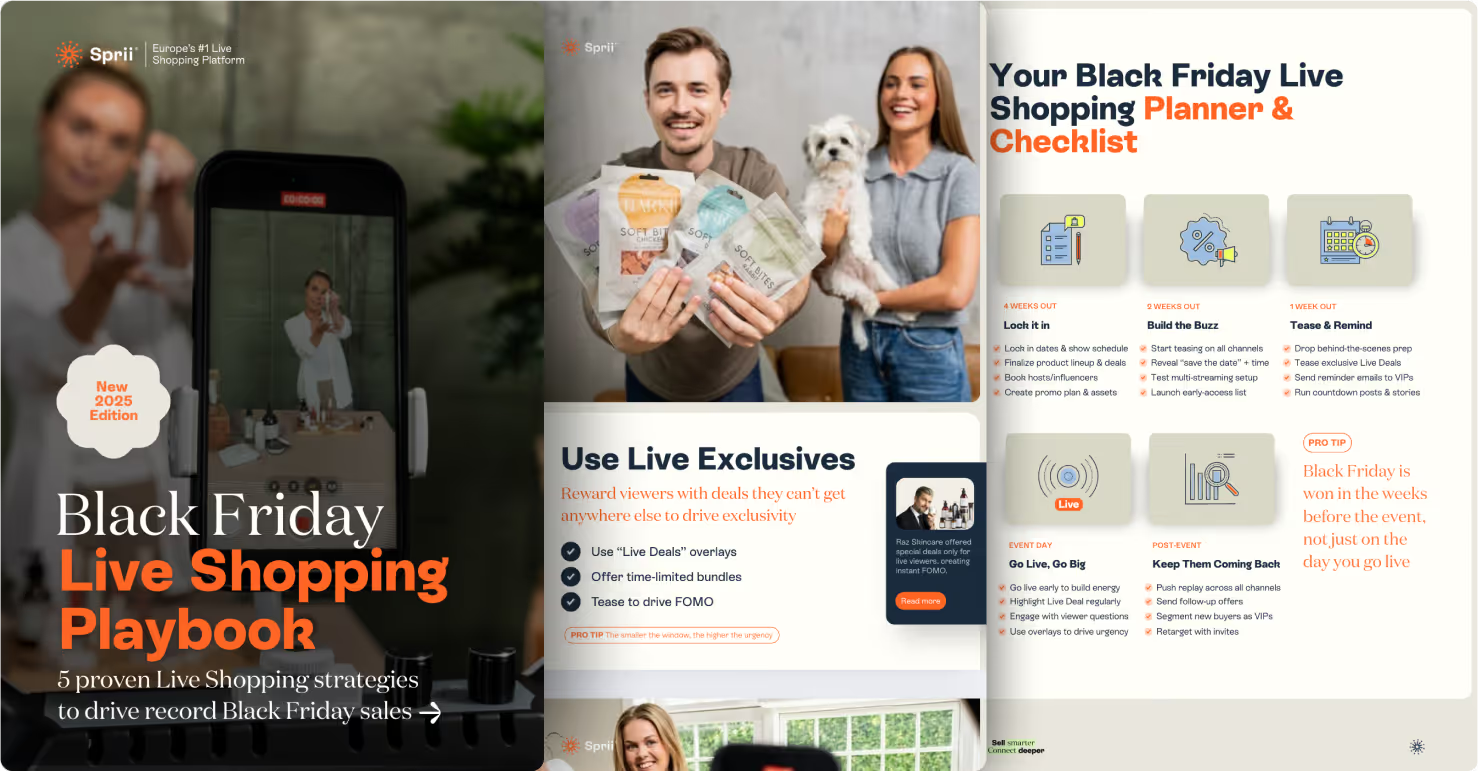
Win the retail rush with this playbook packed with Live Shopping strategies
.webp)
Learn how they compareand discover the 12 key industry benchmarks.
.webp)
BLACK FRIDAY WEBINAR
Learn how leading retailers leverage Live Shopping on Black Friday

See how a Sprii-powered Live Shopping event works on FB, IG and your website
BLACK FRIDAY WEBINAR
Learn about 5 Live Shopping strategies to dominate Black Friday

Master Live Shopping—from audience targeting to driving sales.
5 proven plays to win Black Friday and Black Month with Live Shopping
in under 5 minutes
in under 5 minutes
See How Sprii Works
%201.avif)
See How Sprii Works
Inside Live Shopping
%201.avif)
Inside Live Shopping
.webp)