Video commerce - everything you need to know
Video commerce is changing how businesses interact with customers. Shopping online used to mean scrolling through static images, buying it and hoping a product looked right. Video commerce changes that. By letting people shop directly through video, it turns passive scrolling into an real-time engagement.
%20(8).webp)

Quick Summary
It helps break down the barriers e-commerce often faces and make online shopping feel more like shopping in a real store than a static product page ever could. Depending on the type of video commerce customers can watch, ask questions, and buy — all in one place.
For e-commerce brands, this shift matters. Attention is harder to hold, acquisition costs keep climbing, and static pages struggle to communicate what makes a product genuinely worth buying. Video gives brands a way to demonstrate, connect, and convert at the same time.
This guide covers how video commerce works, why it performs, what formats drive results, and how to build it into your existing setup.
What is video commerce?
Video commerce is the practice of selling products directly through video content. Rather than directing shoppers to a separate product page after watching a video, the buying experience is embedded within the video itself. Shoppers can discover a product, see it in action, and complete a purchase without ever leaving the video experience.
This can happen across several areas of the customer journey:
- Shoppable video players on websites and product detail pages
- Live shopping events streamed to social media and branded storefronts and websites
- Short-form video clips on social media with embedded product links
- On-demand video content with interactive product overlays
The common thread is that interactive video and the transaction are seamlessly connected — not separated by clicks and redirects.
It is worth distinguishing video commerce from standard video marketing.
- A brand video on YouTube that drives awareness is video marketing.
- A shoppable livestream where viewers add products to their cart in real time while a host answers their questions is video commerce.
The difference is intent and infrastructure: video commerce is built to convert, not just communicate.
.webp)
The most well-know types of video commerce
When people normally talk about video commerce, they typically mean:
- Interactive Video: Engaging video content that lets viewers interact through clickable hotspots, product tags, quizzes, polls, and other interactive elements, creating a more immersive shopping experience.
- Shoppable Video: Video content with embedded product links or clickable product tags that enable customers to browse and purchase products directly without leaving the video.
- Live Shopping: Real-time livestream shopping events where hosts demonstrate products, answer customer questions, and encourage purchases through interactive, live video experiences.
Compared to traditional e-commerce, the ability to shop with video gives customers far more information before they commit. They see how a jacket moves, how a skincare product applies, how a piece of furniture fits into a real room.
That context reduces uncertainty — and uncertainty is what keeps shoppers from buying.
How video commerce drives conversions and revenue
You shouldn't just do video commerce to do it - you should do it for the sales and performance it brings. The performance gap between video commerce and standard product pages is more substantial than people realize, and it comes down to how people actually make purchasing decisions.
Static images and written descriptions ask shoppers to imagine a product. Video shows them the reality, which removes a significant psychological barrier to buying.
1. Longer sessions, deeper engagement
Video holds attention in a way static pages can't. Shoppers spend more time on pages with video content, and longer session duration correlates directly with higher purchase intent.
Live shopping takes this further: livestreams generate roughly 10 times more comments and interactions than traditional video content. A viewer who watches a product demonstration through to the end is far more likely to add it to their basket than someone who glanced at a photo.
2. Lower return rates
When customers buy based on a thorough demonstration rather than a static description, they buy more accurately. They've seen the true colour, the real size, the fit on an actual person — and they've had their questions answered before checkout, not after delivery.
The impact is measurable. Live shoppers are around 40% less likely to return items than regular online shoppers. And with Live Shopping users report return rates below 10% — well under the 20–30% typical of conventional online retail.
That flows straight to net revenue and cuts fulfilment costs at the same time.
3. Higher conversion rates
Shoppable video consistently outperforms standard product pages, because it allows for better storytelling , and live shopping pushes performance even further. Industry data puts live shopping conversion rates between 20 times the normal rate.
Why the gap? Real-time interaction creates both confidence and urgency. When a host answers a specific question about sizing or ingredients live on air, that shopper no longer has a reason to wait.
Limited-time offers and seeing other viewers buy in the same moment do the rest.
4. Bigger baskets
Average order values rise too. Live hosts can introduce complementary products naturally, in context — "this scarf pairs with the coat you just saw" lands very differently from an automated "you may also like" widget.
Whereas shoppable video sells products in context, and context sells sets.
Take a skincare routine. A static product page sells one moisturiser. A shoppable video walks the shopper through the full routine — cleanser, serum, moisturiser, SPF — each step demonstrated, each product tappable in the moment it appears on screen. The shopper isn't choosing between products anymore; they're buying the routine. The same logic applies to a styled outfit, a made-up living room or a recipe with every ingredient linked.
5. Broader reach
Video commerce doesn't just convert better — it travels further.
Social platforms actively favour live video in their algorithms, pushing streams to followers and new audiences alike, so a livestream reaches people a product page never would.
And with multistreaming, one show goes live on Facebook, Instagram and your own website simultaneously — the same effort, several audiences. Every stream is a discovery channel as much as a sales channel.
Same with shoppable videos on social, where comment selling is switched on. Selling products through the comment section turns every purchase into engagement: a viewer comments a keyword, gets a checkout link straight to their inbox — and that comment is exactly the signal the algorithm rewards.
The pattern across all five is the same: video closes the gap between browsing and buying. Shoppers make better-informed decisions, faster — and better-informed decisions convert higher, return less and spend more.
Integrating video commerce into your existing e-commerce setup
Adding video commerce to your online store doesn't require rebuilding your existing e-commerce setup. Most retailers start by introducing video where it has the biggest impact on customer engagement and conversions, then expand as they gain experience.
Start with Live Shopping
For most brands, Live Shopping is the fastest and easiest way to launch a video commerce strategy.
Instead of relying on static product pages, you host live, interactive shopping events where customers can watch product demonstrations, ask questions in real time, and purchase without leaving the stream. This allows you to recreate much of the in-store shopping experience online while generating immediate sales and valuable customer feedback.
These can either be hosted on your website or social media or multistreamed across all channels.
Many brans retailers begin with quaterly or monthly Live Shopping events before making them a regular part of their marketing calendar.
Add shoppable videos across your website
You've created video content for your social media or gone live, the next step is implemented those videos on your website.
Shoppable videos can be embedded throughout your website to help customers make buying decisions wherever they are in their journey. Popular placements include:
- Product pages for demonstrations and FAQs
- Homepage hero sections to showcase new collections
- Category pages to help shoppers compare products
- Landing pages for campaigns and seasonal promotions
Unlike traditional videos, shoppable videos allow customers to click directly on featured products and add them to their basket without interrupting their browsing experience. This shortens the path to purchase while increasing product discovery and engagement.
The most successful retailers combine both approaches: using Live Shopping to create engaging content and then repurposing those recordings as shoppable replays and evergreen videos across their website.
%20(10).webp)
Seamless integration into your existing setup
One of the biggest concerns retailers have when adopting video commerce is whether it will fit into their existing e-commerce ecosystem. Fortunately, modern video commerce platforms are designed to integrate with the tools businesses already use.
A good video commerce solution should connect directly to your product catalogue, inventory management, checkout, payment providers, and order fulfilment systems. This ensures customers see accurate product availability, pricing, and stock levels while allowing orders to flow through your normal operational processes.
With Sprii, retailers can integrate Live Shopping and shoppable videos into their existing workflow without replacing their current e-commerce platform. Products sync directly from your catalogue, customers complete purchases through your existing checkout, and orders continue through your standard fulfilment process.
Sprii also integrates with shipping providers such as GLS and Shipmondo, enabling automated order handling, flexible shipping options, and free-shipping thresholds. The platform is designed for quick implementation through straightforward integrations, supported onboarding, and dedicated technical assistance.
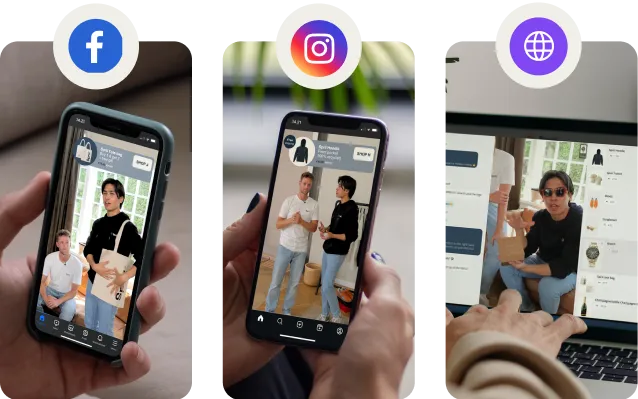
From a single broadcast, brands can simultaneously stream to their website, Facebook, and Instagram, eliminating the need to manage separate live productions for each channel. Combined with onboarding, strategy sessions, production guidance, and ongoing technical support, businesses can launch video commerce quickly while continuing to use the systems they already rely on.
Video content types that sell
Different video formats serve different moments in the customer journey, and the brands that perform best with video commerce tend to use a mix rather than relying on a single type.
Product demos are the foundation. Showing a product being used in real conditions — not just displayed — answers the questions shoppers are actually asking. Does this foundation blend well? How heavy is this pan? Does this jacket look stiff or does it move naturally?
Tutorial and how-to videos go a step further by showing the full experience of using a product. They are particularly effective for beauty, craft, and home goods categories, where the process of using something is as important as the product itself.
Customer testimonials and user-generated content provide social proof in a format that feels credible rather than polished. Shoppers trust other shoppers, and seeing a real person describe their experience with a product carries more weight than brand-produced copy.
Behind-the-scenes content builds brand trust by showing the people and process behind the products. It humanises the brand and creates the kind of connection that keeps customers coming back. Comparison videos help shoppers who are deciding between options make confident choices without needing to research elsewhere.
Short-form social clips drive traffic to live events and product pages, acting as the top of the funnel that feeds the rest of the video commerce strategy. Across all of these formats, storytelling is the constant — products sold through narrative and context convert better than products simply displayed.
Shoppable video and interactive product features
What makes a video shoppable is the layer of commerce functionality built on top of the video itself. Without that layer, a product demonstration is just content. With it, the video becomes a sales channel.
The core mechanics include clickable product tags and hotspots that appear on screen as products are shown, allowing viewers to tap or click for more details or to add directly to their cart. Product overlays display pricing, variants, and availability without interrupting playback. Embedded checkout keeps the entire purchase journey within the video experience, eliminating the drop-off that happens when shoppers are redirected elsewhere.
Recommended product features extend the session by surfacing related items based on what the shopper is watching. Add-to-cart buttons timed to appear at the right moment — when a host is actively demonstrating a product — capture purchase intent at its peak rather than asking shoppers to remember what they wanted after the video ends.
For brands looking to explore the broader potential of these tools, enterprise video commerce solutions offer a full picture of how interactive video infrastructure can be built to scale. The goal across all of these features is the same: reduce friction between interest and purchase so that the gap between watching and buying is as small as possible.
.png)
Live shopping and livestream commerce explained
Live shopping is the highest-engagement format within video commerce. A host broadcasts in real time, demonstrating products, answering audience questions, and guiding viewers through a buying experience that feels personal and immediate in a way pre-recorded content simply cannot replicate.
The combination of live product demonstrations and real-time Q&A is particularly powerful. A shopper who is unsure about a product's size, material, or compatibility can ask directly and receive an answer within seconds. That interaction removes the hesitation that causes abandoned carts on static pages. Brands that have explored scaling fashion brands with video consistently report that live formats outperform pre-recorded content for conversion precisely because of this dynamic.
Limited-time offers and exclusive live-only deals add urgency without feeling manufactured, because the scarcity is real — the event is happening now, and the offer ends when it does. Community engagement builds over time as regular viewers return for scheduled shows, creating loyalty that extends well beyond a single transaction.
The practical differences between live shopping and pre-recorded shoppable video matter for planning. Live events require scheduling, hosting, and real-time moderation, but they generate higher engagement and stronger conversion. Pre-recorded shoppable video is more controlled and works well as always-on content on product pages and homepages. Most effective video commerce strategies use both — live events to drive peaks in revenue and community, on-demand video to convert shoppers between events. For a deeper look at how these formats connect, the comprehensive guide to live commerce covers the full picture.
User-generated content and social commerce
User-generated content (UGC) — videos created by real customers showing products in authentic, everyday settings — is among the most trusted content types for online shoppers. Over 60% of shoppers are more likely to buy when a product page includes customer video. UGC can be collected from social platforms, repurposed into shoppable experiences, and embedded on product pages or used in live shows.
Social commerce extends this further: platforms like Instagram and Facebook allow product links directly within video posts, turning organic shares into purchase moments. 92% of mobile video viewers are likely to share content they enjoy, amplifying brand reach organically. Sprii's platform integrates with Facebook and Instagram, enabling brands to stream shoppable events to social audiences and convert viewers into buyers without redirecting them away from their feed.
Optimising video for mobile shoppers
Over 70% of e-commerce traffic originates from mobile devices, making mobile-first video delivery essential. Videos must load in under three seconds — 53% of mobile users abandon a page that takes longer. Vertical formats (9:16 aspect ratio) suit Instagram Reels, TikTok, and mobile browsers. Subtitles and captions are critical because many mobile users watch on mute in public settings.
For live shopping specifically, mobile viewers expect seamless real-time interaction: chat, product taps, and one-click checkout must all function without friction on a small screen. Sprii's platform is built to deliver shoppable live events and on-demand video across website and social channels with consistent performance on mobile, ensuring that the interactive features — product overlays, chat, automated checkout — work as smoothly on a phone as on desktop.
Measuring ROI from your video commerce activity
Key metrics to track across video commerce activity include views, click-through rates (CTR), add-to-cart events, conversion rates, revenue per stream, average order value, and return rates. Engagement metrics such as watch time and live chat participation indicate content quality and audience connection. A/B testing different CTA placements, video lengths, and product sequencing helps optimise future shows.
Sprii provides analytics that give brands clear visibility into which live events and video formats drive the most revenue, enabling data-led decisions about content strategy, product selection, and broadcast scheduling. Tracking return rates alongside conversion data is particularly valuable: Sprii's interactive format consistently reduces returns to below 10%, which directly improves net revenue and reduces operational costs — a measurable ROI advantage over standard e-commerce product pages.
Production quality and best practices for video commerce
High production quality signals professionalism and builds purchase confidence. HD or 4K resolution, proper lighting, and clear audio are baseline requirements — grainy footage or muffled sound causes viewers to disengage and associate poor quality with the brand itself. Fashion retailers should capture fabric texture and fit clearly; home goods brands benefit from styled, real-room settings; beauty brands need close-up skin and colour accuracy.
Consistent branding across all video content — colour palette, tone, on-screen graphics — reinforces recognition. CTAs should appear at natural breakpoints, not mid-sentence, using action language such as 'Shop Now' or 'Limited Stock.' For live shows, Sprii offers live show production assistance as part of its onboarding and support offering, helping brands go live with confidence from their very first event — no broadcast experience required.
For brands curious about what the experience actually looks and feels like before committing, it is worth exploring what engaging audiences through shoppertainment looks like in practice, or to book a live shopping demo and see the platform in action firsthand.
Frequently asked questions
What is a video commerce platform?
A video commerce platform is software that combines video content with e-commerce functionality, enabling brands to sell products directly through video experiences. This includes shoppable videos with embedded product links, live shopping events with real-time checkout, and on-demand video with interactive overlays. Platforms like Sprii go further by providing multistreaming to website and social channels simultaneously, automated order and shipping management, and analytics to track revenue generated from each video event — making video a measurable sales channel rather than just a content format.
How does video commerce differ from standard e-commerce?
Standard e-commerce relies on static product pages with images and text descriptions. Video commerce replaces or supplements these with dynamic video content — live streams, shoppable clips, tutorials, and testimonials — that show products in action and allow shoppers to interact in real time.
This reduces purchase uncertainty, builds trust, and shortens the path to checkout. The result is measurably higher conversion rates (30–40% uplift is commonly reported) and significantly lower return rates, since shoppers make more informed decisions before buying.
What types of video work best for selling products online?
The most effective video formats for e-commerce include: live shopping events (real-time demonstrations with audience Q&A and instant checkout); shoppable product videos embedded on product pages; how-to and tutorial videos that show products in use; customer testimonial and UGC videos that provide social proof; behind-the-scenes content that builds brand trust; and short-form social clips that drive traffic to live events or product pages.
The right mix depends on your product category — fashion and beauty brands often see strong results from live shows and tutorials, while home goods and hobby brands benefit from detailed how-to demonstrations.
How much can video commerce improve conversion rates?
Research consistently shows significant conversion uplifts from video commerce. Websites using shoppable video report 30–40% higher conversion rates compared to standard product pages. Over 60% of shoppers say they are more likely to buy a product when its page includes customer video. Live shopping events tend to perform even higher because real-time interaction — product demonstrations, live Q&A, and limited-time offers — creates both confidence and urgency.
Sprii's platform has helped 3,000+ brands generate hundreds of millions in revenue through live shopping events, with return rates consistently below 10%.
Can small and mid-sized retailers use video commerce, or is it only for large brands?
Video commerce is accessible to businesses of all sizes. Many boutiques and independent retailers have successfully adopted live shopping as their primary sales channel, often outperforming larger competitors by offering a more personal, community-driven experience. Platforms like Sprii are designed with ease of implementation in mind and provide hands-on onboarding, strategy sessions, and live show production assistance — so brands without broadcast experience can go live confidently.
The multistreaming capability means a small team can reach audiences on their website, Facebook, and Instagram simultaneously from a single broadcast, maximising reach without additional resource.
How does live shopping reduce product return rates?
Live shopping reduces returns because shoppers make more informed purchasing decisions before checkout. During a live event, hosts demonstrate products in real conditions — showing fabric drape and fit for fashion, texture and colour accuracy for beauty products, or scale and assembly for home goods — and answer audience questions in real time.
This eliminates the uncertainty that drives returns in standard e-commerce, where shoppers rely on static images and written descriptions. Sprii's interactive live shopping format consistently reduces return rates to below 10%, compared to industry averages of 20–30% for conventional online retail.
Which product categories benefit most from video commerce?
Video commerce delivers strong results across a wide range of categories. Fashion and apparel benefit from live demonstrations of fit, fabric, and styling. Beauty and skincare brands use live shows to demonstrate application techniques and real skin results. Home goods and furniture retailers showcase products in styled room settings to help shoppers visualise scale and aesthetic. Food and beverage brands use live cooking and tasting formats.
Hobby and craft retailers build loyal communities through tutorial-style live events. Baby, pet care, and electronics categories also perform well when hosts can demonstrate product functionality and answer specific buyer questions in real time.
Use our Live Shopping calculator to see how much you could earn.

you could possibly earn
you could possibly earn
Unleash the power of Live Shopping with Sprii's 5-part bootcamp series!
%201.webp)
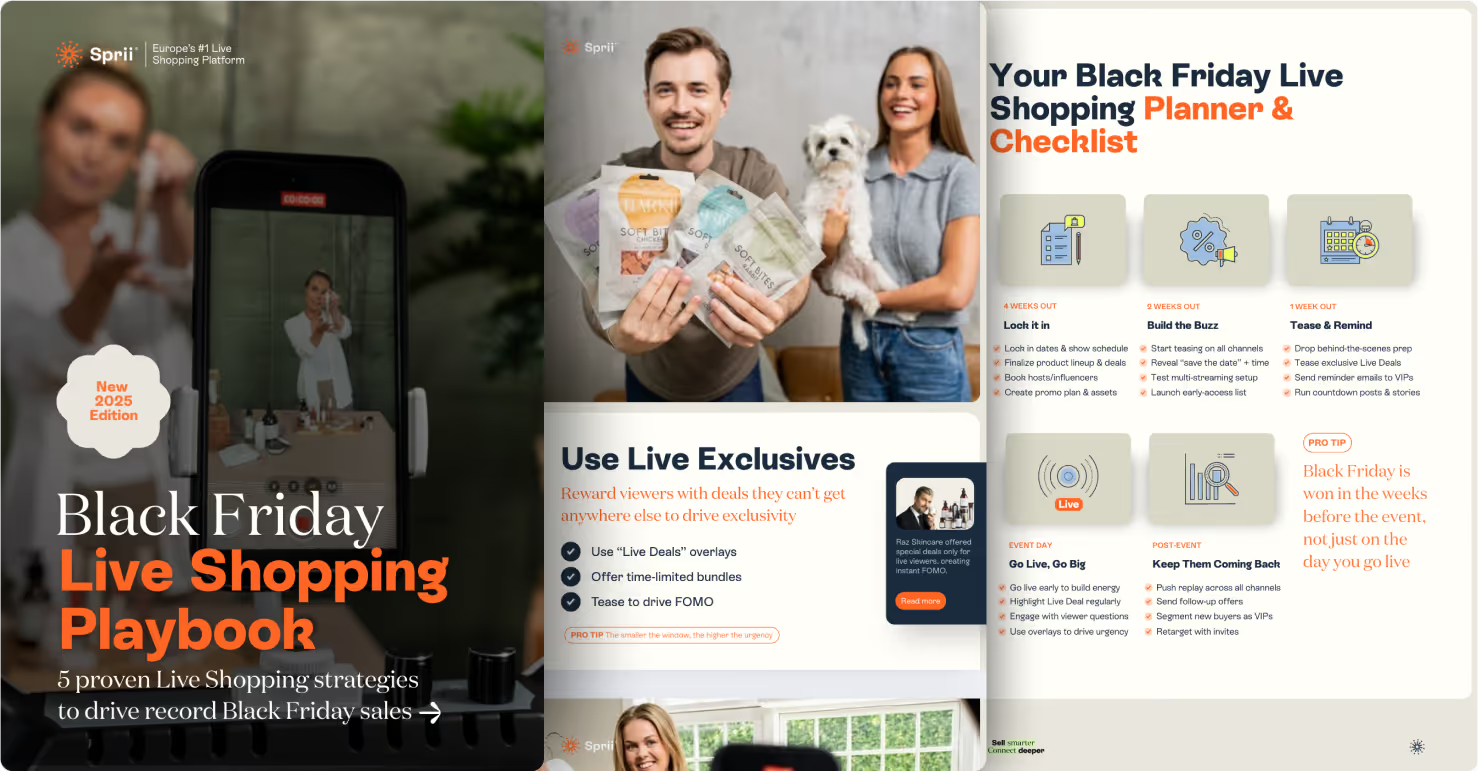
Win the retail rush with this playbook packed with Live Shopping strategies
.webp)
Learn how they compareand discover the 12 key industry benchmarks.
.webp)
BLACK FRIDAY WEBINAR
Learn how leading retailers leverage Live Shopping on Black Friday

See how a Sprii-powered Live Shopping event works on FB, IG and your website
BLACK FRIDAY WEBINAR
Learn about 5 Live Shopping strategies to dominate Black Friday

Master Live Shopping—from audience targeting to driving sales.
5 proven plays to win Black Friday and Black Month with Live Shopping
in under 5 minutes

in under 5 minutes
See How Sprii Works
%201.avif)
See How Sprii Works
Inside Live Shopping
%201.avif)
Inside Live Shopping



.avif)
.avif)